Scope Chain and Lexical scope
What is scope in java script ?
Scope simply means an area where the program can access a particular variable or a function.
Types of scope –
- Global Scope
- Local Scope/ Functional Scope
- Block Scope
Global Scope
var greeting = 'Hello World!';function greet() {
  console.log(greeting);
}
// Prints 'Hello World!'
greet();
Local Scope
function greet() {
  var greeting = 'Hello World!';
  console.log(greeting);
}// Prints 'Hello World!'
greet();
console.log(greeting);
Block Scope
{
  let greeting = 'Hello World!';
  var lang = 'English';
  console.log(greeting); // Prints 'Hello World!'
}// Prints 'English'
console.log(lang);// Uncaught ReferenceError: greeting is not defined
console.log(greeting);
Scope of a variable is directly proportional to its lexical scope
What is scope chain ?
Diagram showing scope chain and lexical scope
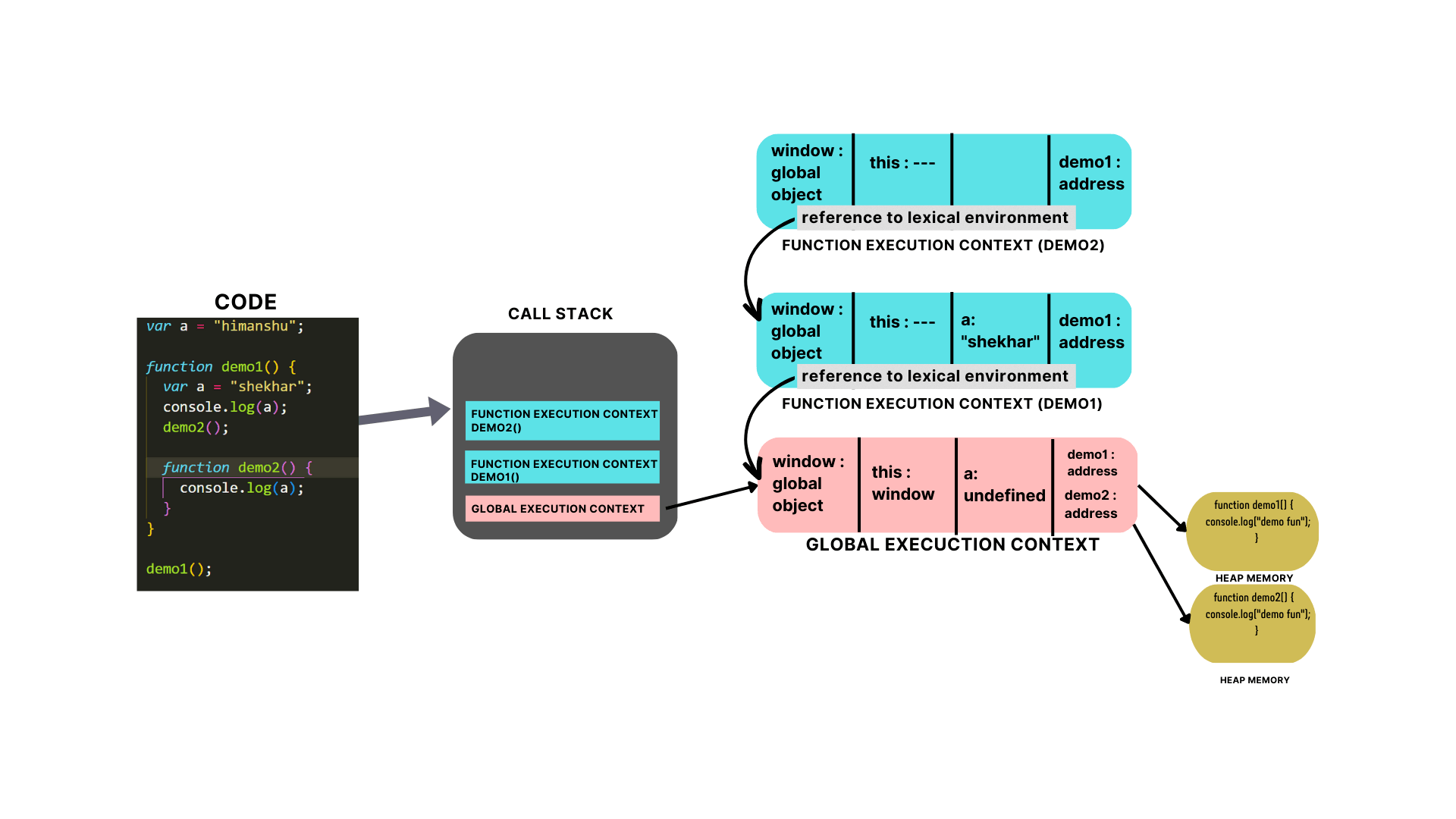
Let understand this with an code –
var a = "himanshu";
functiondemo1(){
var a = "shekhar";
console.log(a);
demo2();
functiondemo2(){
  console.log(a);
}
}
demo1();
Taking the above example , the js pointer , does not directly jump to global space and find the variable a , instead it follow as specific path –
- first, it search inside demo2() , if not found then ,
- it goes to the outer/parent function , if not found then,
- it searches in the global scope ,
thus forming a chain , known as scope chain.
demo2() scope ---> demo1() scope ---> global scopeWhat is Lexical Scope ?
Also know as static scope.
Lexical environment of a variable is a combination of -
- local memory and
- parent lexical scope
Lets understand this with an code example –
var a = "himanshu";
functiondemo1(){
var a = "shekhar";
console.log(a);
demo2();
functiondemo2(){
console.log(a);
}}
Practice –
Question 1 –
const fullName = "Jhon";

function profile() {
  const fullName = "Tobi";
  console.log(fullName);
  function sayName() {
    console.log(fullName);
    function writeName() {
      const fullName = "Shah";
      console.log(fullName);
    }
    writeName();
  }
  sayName();
}
profile();
Question 2
function showLastName() {
  const lastName = "Sofela";
  return lastName;
}

// Define another function:
function displayFullName() {
  const fullName = "Oluwatobi " + showLastName();
  return fullName;
}

// Invoke displayFullName():
console.log(displayFullName());